The Bluetooth Discovery
By January 19th, Guertin had already unplugged his Ethernet cable, uninstalled his Wi-Fi adapter driver, and physically disconnected his cable modem. His custom-built workstation — the same machine he'd used for three years without a single crash — was completely severed from the internet. Or so he thought.
While running his routine CCleaner diagnostic — a habit he'd developed weeks earlier for catching suspicious scripts phoning home to external sources — he discovered that successful external communication attempts were still occurring from his machine. Upon investigation, he found two small antennas still attached to the built-in wireless adapter of his motherboard, and critically, an active Bluetooth Personal Area Network (PAN) listed in his Network Connections. He had never set it up. He had never enabled it.
Bluetooth has a maximum effective range of approximately 30 feet.
Whoever was connected to his machine was physically inside his apartment building.
The threat that had been "out there" — distant, digital, abstract — had arrived at his doorstep. His reaction was immediate: he killed the power supply by physically flipping the switch on his PSU.
What followed was the precipitating traumatic event that an independent forensic psychologist would later classify as meeting Criterion A for Acute Stress Disorder under DSM-5-TR: the direct experience of threatened death or serious injury to self. The threat was no longer theoretical. It was within the walls of his building. And every institutional channel he'd tried — FBI, Secret Service, local police — had either hung up on him, told him it was beyond their scope, or validated his concerns but offered no protection.
Minnetonka, January 21, 2023
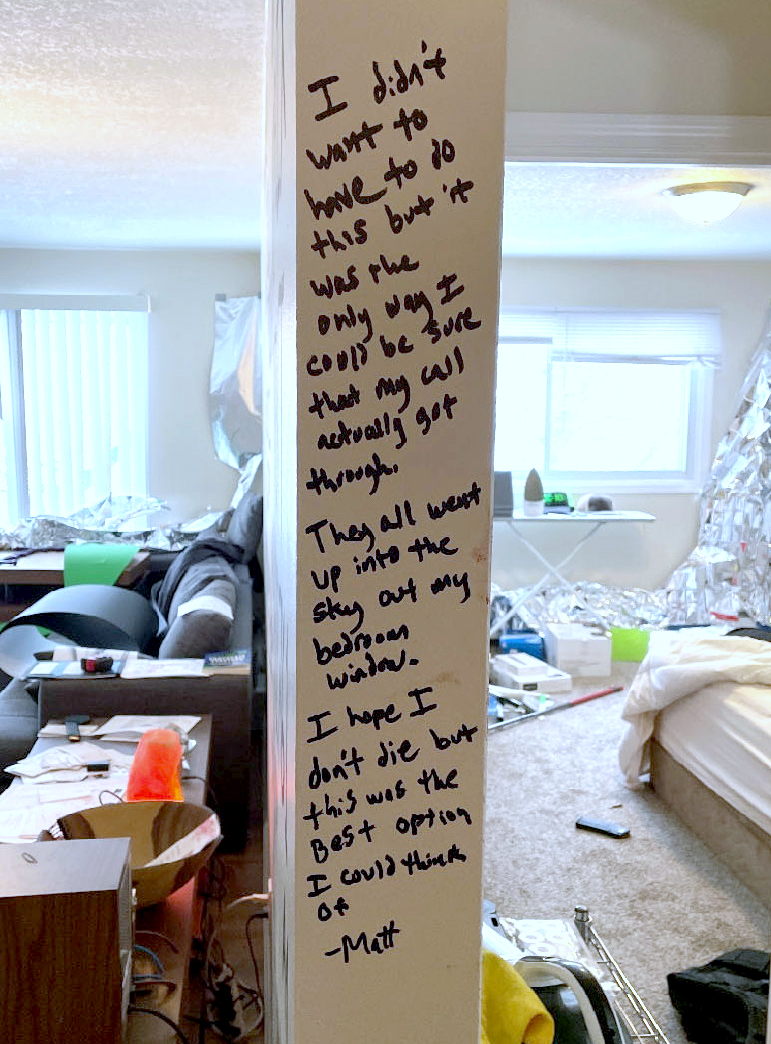
Left: Police photograph — "I didn't want to have to do this but it was the only way I could be sure that my call actually got through. They all went up into the sky out my bedroom window. I hope I don't die but this was the best option I could think of. —Matt" Right: Local news — "Peaceful Ending to a Scary Situation for a Guy Named Matthew in Minnetonka Today"
They Were Watching. The Emails Prove It.
Here is the fact that ties everything together — the one detail that transforms the entire preceding narrative from a troubling sequence of events into something that cannot be explained away.
Guertin's LinkedIn profile — "MattGuertin612" — was dormant. Never completed. Never promoted. Never used for outreach. His only connections were a handful of LA entertainment colleagues from his previous six years on the West Coast. Over 35 months, it accumulated 597 profile searches from 194 distinct entities spanning government, military, defense, intelligence, entertainment, medical, and financial sectors — all documented via 99 DKIM-authenticated LinkedIn notification emails with a 100% cryptographic pass rate.
On January 21, 2023 — the offense date for all four criminal charges in case 27-CR-23-1886 — LinkedIn reported that the following entities had searched for Guertin's profile:
Forcepoint — a global cybersecurity firm specializing in insider threat monitoring and government intelligence solutions. Their tagline: "We provide intelligence, investigations, and information solutions for statecraft, national security, and law enforcement missions." Their Executive Advisory Board includes Major General Joseph Brendler (Ret.), USCYBERCOM; Marianne Bailey, NSA/DoD; Robert Bigman, CIA; Rear Admiral William Leigher (Ret.), DoD/U.S. Navy; and advisors spanning "all facets of the United States government relating to civilian, defense and intelligence agencies."
3GIMBALS — a defense and intelligence company.
Fox Corporation — a major media entity operating in the same entertainment/VFX space as the patent.
Source: DKIM-authenticated LinkedIn notification email, week ending January 21, 2023. Filed as Exhibit EML-C (Doc. 63) in Guertin v. Walz, 0:25-cv-02670-PAM-DLM.
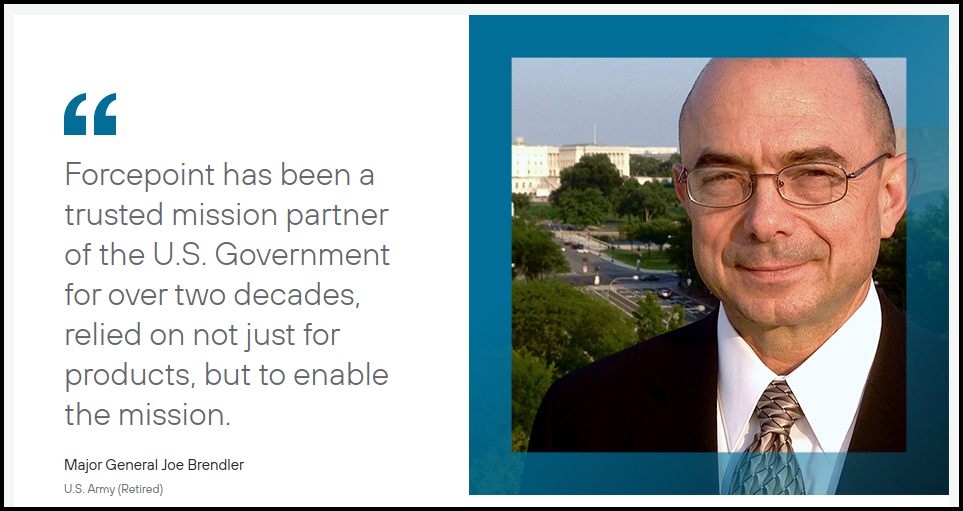

Forcepoint.com — "Global Government Cybersecurity" landing page and Executive Advisory Board. Click to enlarge.
The same day. Not the same week. Not plus-or-minus a few days. The offense date — January 21, 2023 — is the exact date the criminal charges originate. And on that date, a cybersecurity firm whose advisory board is staffed by a retired Major General from USCYBERCOM, a former CIA information security officer, and senior NSA/DoD officials searched for the LinkedIn profile of a man who had spent the previous eleven weeks telling anyone who would listen that his computers were being hacked and his patent was being stolen.
The same man the court system would later declare delusional for believing people were watching him.
This was not the first time. The LinkedIn search data — which the Theft & Surveillance page documents in full — shows a consistent pattern of defense and intelligence-adjacent entities appearing at precise case milestones:
The patent itself has documented military training simulation applications — soldier traversal of virtual terrain, VR/LED volume integration, digital twin creation, AI-driven environment generation — capabilities aligned with the US Army's $10 billion+ Synthetic Training Environment (STE) program. The defense/intelligence entities appearing in the LinkedIn data are the same categories of entities whose research programs align with these capabilities. Paul Debevec's USC-ICT lab, which presented the rotating treadmill at SIGGRAPH 2023 for Netflix, receives $8.89 million in direct US Army/DoD funding.
And two of the judicial officers who would preside over Guertin's case have publicly documented military backgrounds: Judge William H. Koch, former JAG Officer, United States Air Force (1988–1991), Andrews Air Force Base — the same branch that appears multiple times in the LinkedIn data; and Referee Danielle C. Mercurio, former JAG Officer, United States Army National Guard (2011–2020), appointed to the 4th Judicial District on April 19, 2021 — exactly 28 days after Guertin's patent provisional filing.
To be clear: The LinkedIn Search Timeline Report and the Military Simulation Alignment Report do not assert surveillance, targeting, coordination, or conspiracy. They present three independently documented data streams — patent military applications, authenticated LinkedIn search activity, and publicly documented judicial officer military backgrounds — mapped onto a unified forensic timeline. The temporal correlations are presented as measurable patterns. Whether they reflect coincidence, algorithmic behavior, or other factors remains an open question. Every data point is independently verifiable from its original source.
The 60-Hour Crisis
Over the next sixty hours — from the evening of January 19th through the morning of January 21st — Guertin slept approximately three hours total. His Adderall prescription had run out days earlier due to COVID-era stimulant supply chain disruptions, and he had been unable to refill it. The combination of Acute Stress Disorder, near-total sleep deprivation, and abrupt ADHD medication withdrawal produced a crisis state that was extreme, terrifying, and — according to independent forensic analysis — clinically predictable.
His apartment, a one-bedroom unit on the third floor of a building in Minnetonka, Minnesota, doubled as his full-time fabrication studio and the corporate headquarters of InfiniSet, Inc. The completed working prototype sat in the room with him. The apartment had two entrance doors: a front door and a rear door. The rear door's shared kitchen wall connected to an adjacent unit occupied by a single male tenant who had moved in only months prior — someone Guertin had never met.
In the hours that followed the Bluetooth discovery, Guertin's behavior escalated through what the forensic report describes as a predictable, time-dependent progression:
Duct-taping deadbolts. Hanging Mylar space blankets over windows and walls. Wrapping electronic devices in aluminum foil. Running the dishwasher continuously against the shared wall for acoustic masking. Writing on the apartment walls in permanent marker and black paint — patent numbers, case numbers, names, the Minnetonka PD case number from nine days earlier. "I did not want to have to do this. I am scared they are going to kill me. All of the shots went up into the sky out of the window. I hope I don't die."
An independent forensic psychologist who later analyzed the crisis period identified 12 of 14 possible DSM-5-TR symptoms across all five diagnostic categories — well exceeding the threshold of 9 required for an Acute Stress Disorder diagnosis. The symptoms drew from every category: intrusion, negative mood, dissociation, avoidance, and arousal. The report specifically notes that despite operating within the 48–90 hour sleep deprivation window — the zone associated with complex perceptual disturbances and disordered thinking — Guertin "maintained a remarkably coherent internal logical structure," a finding that speaks to both his high premorbid cognitive reserve and the nature of his condition as stress-induced rather than psychotic.
An Analog Signal in a Compromised Digital World
The decision to fire a weapon out of his third-floor bedroom window at approximately 11:30 AM on Saturday, January 21, 2023, was not random, impulsive, or psychotic. It was, in the forensic psychologist's assessment, an "extreme but internally coherent crisis response by a cognitively intact individual operating under conditions of perceived imminent mortal threat."
Having discovered that his digital communications were compromised — and having encountered AI-generated fake people with synchronized synthetic voices just days earlier — Guertin concluded that he could not trust any digital medium to reliably connect him with legitimate authorities. He could not be certain he was actually speaking to a real person on the phone. He could not be certain his emails were being received. He could not be certain his Dropbox files hadn't been tampered with.
His reasoning was documented by the forensic psychologist as "sophisticated meta-reasoning about the reliability of communication channels": a gunshot is analog. It cannot be intercepted, blocked, deleted, or faked by digital means. It is the one signal that guarantees a real, physical response from real, physical authorities.
Every element of what followed was deliberate:
Timing: Saturday at 11:30 AM. Daylight conditions would make police response safer. All neighbors would be home, providing witnesses who knew him personally. Responding officers would be alert rather than fatigued from night shifts.
Barricading: He secured both doors using mechanical means — the rear door with a custom metal frame and Gorilla tape, the front door with a scissor jack and rigid conduit pipe. He identified the interval between firing the weapon and police arrival as the period of maximum vulnerability.
Evidence preservation: He threw patent documents and evidence out the window before the firearms — so they would land in the snow below. He then threw the firearms out, which landed on top of the documents. Police evidence photographs show patent numbers, drawings, and articles about the "adversaries" all visible in the same frame as the recovered weapons.
Wall documentation: He wrote the evidence on his walls in permanent marker and paint — creating an analog record that could not be digitally erased or altered. The patent numbers. Netflix. Trojansky. Eyeline Studios. The Minnetonka PD case number. He knew it would appear surreal. He also knew it would become part of the court record.
Officer verification: When police arrived, Guertin asked the responding officer to describe the lobby of the Minnetonka Police Station — a test only a genuine local officer could pass. The officer described the mural of historic police badges. Only then did Guertin accept he was communicating with a legitimate authority.
The forensic report's conclusion is unambiguous: "Mr. Guertin's behavior was extreme — no clinician would dispute this. But it was extreme in a structured, purposeful, and goal-directed manner that is characteristic of an intact cognitive system operating under extraordinary perceived threat. His actions are better conceptualized as the upper boundary of adaptive stress responding rather than the lower boundary of psychotic decompensation."
"My Patent. Netflix Patent. Trojansky. Eyeline Studios. Kill Me → Steal."
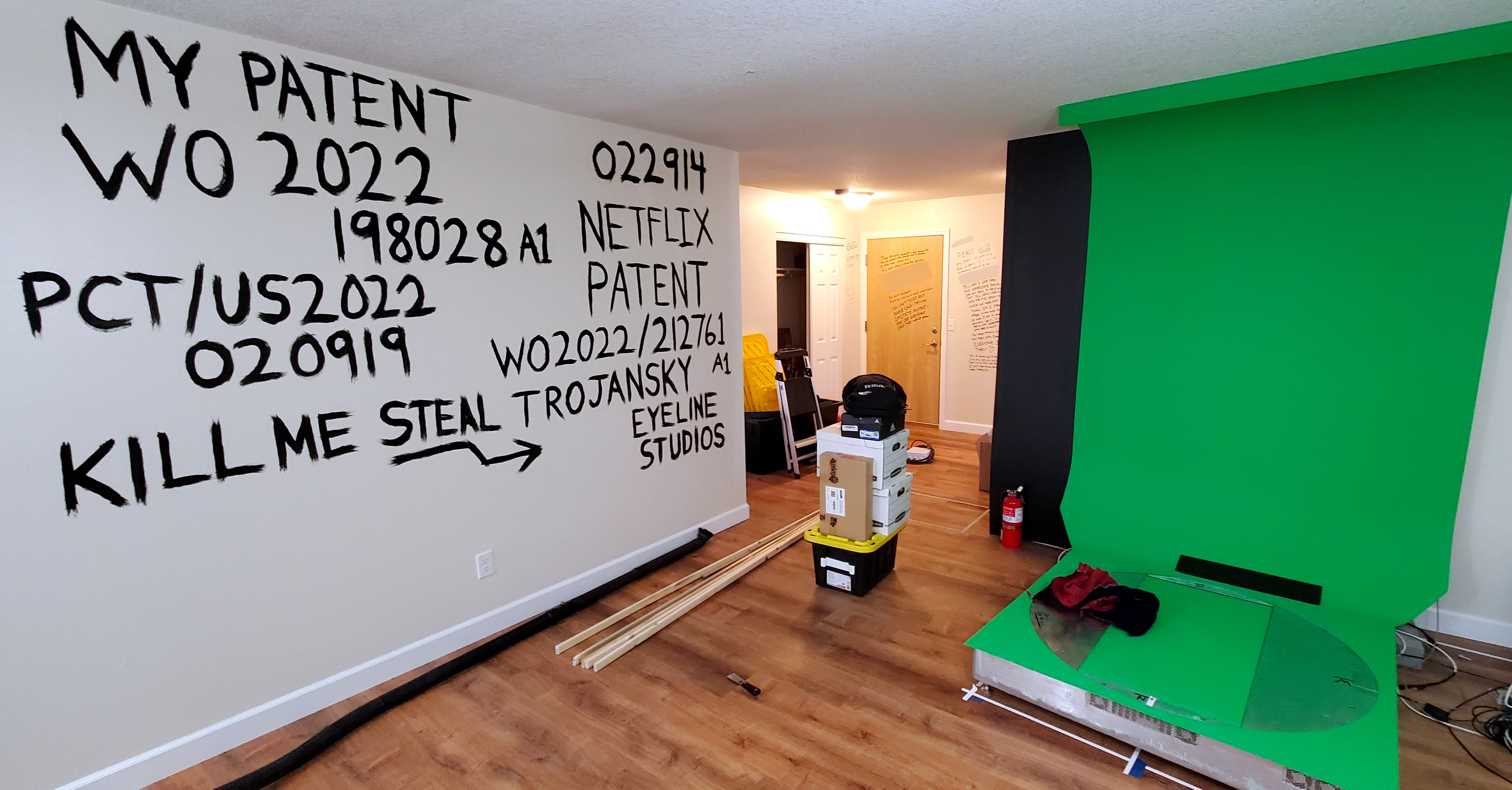
The image above is not the product of a disorganized mind. It is the product of a person who believed he was about to die and wanted to make sure the story couldn't be erased. The patent numbers are accurate. The case references are accurate. The names are accurate. And the arrow between "KILL ME" and "STEAL" is a thesis statement written in paint, on a wall, by a man who had spent eleven weeks trying to tell anyone who would listen.
From Arrest to Incompetency
Four days after the arrest, a Rule 20 competency evaluation was ordered. Twenty-four days after the arrest, his patent was granted — US 11,577,177 B2, 6 claims. Three days after the patent grant, Guertin filed third-party prior art against Netflix's application, sending certified mail to 12 recipients. The evaluation that would classify his patent claims as delusional was filed on March 10th — by an evaluator who acknowledged "the limits of my expertise in relation to technology matters" and never entered a patent number into a free government database.
The evaluation was already in motion before the patent was officially granted. The competency question had been answered before it was asked.
Netflix Whistleblower Is Found Alive and Well
In December 2023, nearly a year after the arrest and with two findings of incompetency already entered against him, Guertin published the full account of the preceding months on Substack. "Part 1 — The Patent" is a 242-page narrative reconstructed entirely from authenticated emails, documents, and timestamps. It was later filed as Exhibit A (Index 128) in the state court case. The document you are reading now draws heavily from it.
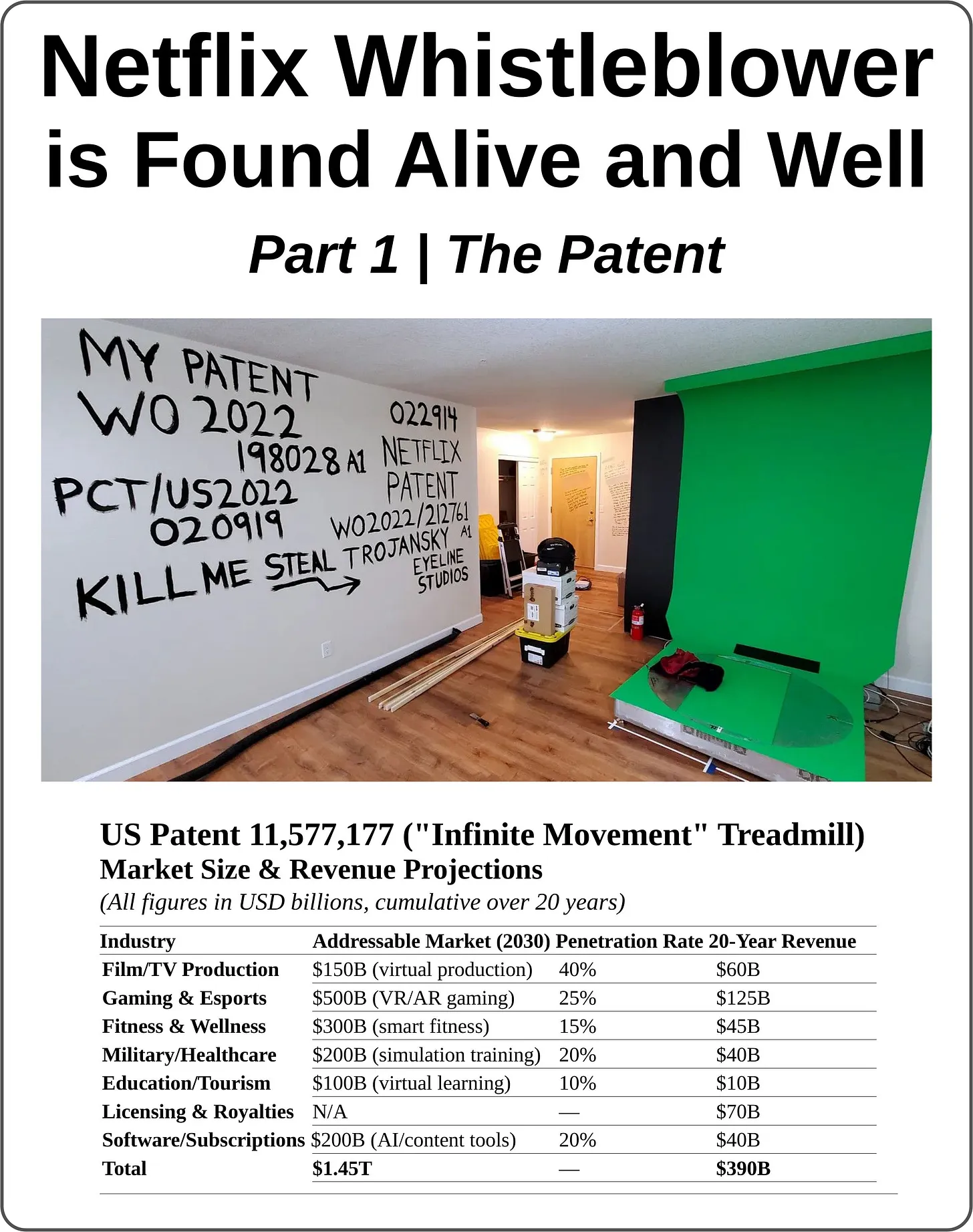
"Netflix Whistleblower Is Found Alive and Well"
Part 1 — The Patent
The complete story, told chronologically through 82 authenticated emails, from the first patent publication notice on September 26, 2022, through the last email sent three days before the arrest. Every claim is documented. Every email is verifiable. Every timestamp is real.
The cover image — a photograph of the apartment walls alongside the patent's market valuation — captures the surreal juxtaposition that defines this case: a $1+ trillion addressable market, a 6-claim granted patent, and an inventor writing on his walls in paint because he believed no digital channel was safe.
READ ON SUBSTACKForensic Psychological Analysis Report
The following report was produced using AI (Claude) operating as a board-certified forensic psychologist. It is not a traditional expert report — it is an evidence-based forensic analysis produced by having AI examine the actual documented record: court filings, contemporaneous email correspondence, the Minnetonka PD police report, the Substack narrative, and Guertin's own statements. The AI was given no instructions to reach a particular conclusion. It was given facts and asked to apply DSM-5-TR diagnostic criteria. The result is an unbiased analysis that directly contradicts the court-appointed evaluators' diagnoses — because the evidence contradicts them:
"Mr. Guertin's actions, while unlawful, represent an extreme but internally coherent crisis response by a cognitively intact individual operating under conditions of perceived imminent mortal threat... His behavioral presentation is inconsistent with psychotic disorder and instead represents the adaptive, if extreme, functioning of a rational mind under extraordinary duress."
Forensic Psychological Analysis Report — AI-produced analysis using Claude, applying DSM-5-TR diagnostic frameworks — March 18, 2026
The report identifies Guertin's diagnosis as Acute Stress Disorder (DSM-5-TR 308.3 / F43.0), compounded by severe sleep deprivation (~3 hours across 60 hours), abrupt cessation of prescribed ADHD medication, and cumulative psychosocial stress spanning approximately eleven weeks. It explicitly distinguishes this from the schizophrenia-spectrum diagnosis applied by the court's evaluators — noting that the cardinal feature differentiating acute stress from psychosis is preserved metacognitive monitoring: the capacity to observe and evaluate one's own mental states. Guertin repeatedly questioned whether his perceptions were real. A person experiencing genuine psychosis does not question their perceptions — they accept them as veridical. Guertin's active, methodical reality-testing is the opposite of psychotic loss of insight.
The irony is worth pausing on: three human evaluators — each deferring to the one before, none of whom verified a single factual claim — concluded Guertin was psychotic. An AI, given the same documented record and asked to apply actual diagnostic criteria to actual evidence, concluded the opposite. The difference was not the methodology. The difference was that the AI actually looked at the evidence.
What They Never Checked
In the months and years that followed, three successive court-appointed evaluators would examine Guertin. The first acknowledged the limits of her expertise in technology. The second fabricated a substance use history contradicted by his own secretly recorded interview. The third — the supervisor of both prior evaluators — performed zero hours of clinical contact and inherited the diagnosis "based upon record review."
None of them read the 82 emails. None of them reviewed the Minnetonka PD police report. None of them entered a patent number into the USPTO database. None of them contacted the Secret Service agent who had validated the wire fraud assessment. None of them checked whether the Internet Archive manipulation was real. None of them asked why Forcepoint — a government cybersecurity firm whose advisory board includes a retired Major General from USCYBERCOM, a former CIA officer, and senior NSA officials — searched for the dormant LinkedIn profile of their patient on the exact same day the criminal charges originated. None of them wondered why DARPA, the Defense Intelligence Agency, and the US Indo-Pacific Command appeared in that same data on the exact same day the mental health examiner's report was filed. None of them considered that 597 searches from 194 entities on a profile that was never completed, never promoted, and never used might be worth a second look.
They looked at the walls. They looked at the guns. They looked at the space blankets.
They saw a man who wrote "MY PATENT — WO 2022/198028 A1" in black paint on his apartment wall — and that patent is real, searchable in 30 seconds on any government database. They saw a man who wrote "NETFLIX PATENT — WO 2022/212761" — and that patent is real too, granted nine months later with Guertin's patent at the top of its References Cited page. They saw a man who wrote "TROJANSKY — EYELINE STUDIOS" — and Trojansky is the president of Netflix's virtual production division. They saw a man who drew an arrow from "KILL ME" to "STEAL" — and the $100 million acquisition, the 12-day filing gap, the Forcepoint search on the offense date, and the AI-generated fraud operation are all independently verifiable facts that exist in the physical world, in authenticated emails, in public patent records, in a police report, and in federal court filings.
And they concluded he was delusional.
He wasn't delusional. He was terrified. And he was right.